Wednesday, August 19, 2015

ford fusion hybrid 2016

Introduction


Though fuel-efficient hybrid systems were once been limited to small hatchbacks or compacts in the past, that technology has gone mainstream and hybrids are everywhere. You'll find plenty of these fuel-efficient vehicles in the midsize sedan segment, and the 2016 Ford Fusion Hybrid is an excellent example of the breed.

There's a lot to like about the 2016 Ford Fusion Hybrid, including its modern styling, sleek interior and advanced safety features. You could say all that about the standard gasoline-only Ford Fusion, too, but this hybrid version returns an EPA-estimated 42 mpg combined. Basically, the Fusion Hybrid integrates all the positive attributes of the standard Fusion into a more fuel-efficient package. Aside from the mileage, there is still a smooth ride quality on the highway and plenty of space for four passengers. There is a little less trunk space than in the standard model (the battery takes up some of that real estate) but the Fusion Hybrid is on par for cargo space with its hybrid sedan competitors.

On the technology front, the Fusion Hybrid offers several high-tech safety options, including a forward-collision avoidance system, blind spot monitoring and adaptive cruise control. Amidst these modern touches, some drivers may be let down by the MyFord Touch touchscreen electronics interface, which governs most audio, navigation and phone functions. Ford has improved this interface over the years, but the system can still be frustratingly slow to respond to touch inputs at times. Luckily, the Sync voice command system is much more responsive and provides an alternative means of handling basic tasks.


Interior Design and Special Features
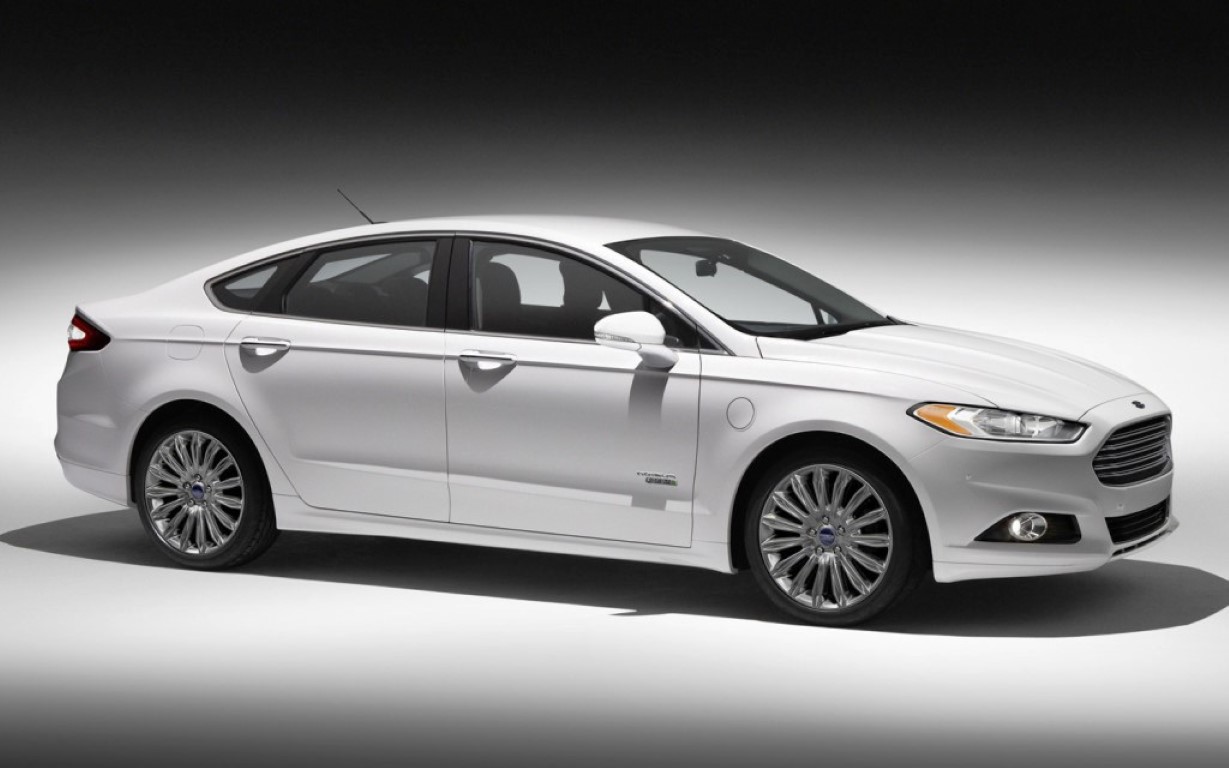
Ford's interior designers got all the basics right in the Fusion Hybrid, with a driver seat that's easy to adjust into a just-right position and good sight lines out the front and sides. It's harder to see through the sloping rear window, so it's helpful that a rearview camera comes standard.

Sharp angles and a sleek look throughout help the 2016 Ford Fusion's interior echo the handsome styling of the exterior. The emphasis is on having large, nicely textured surfaces and removing extraneous clutter, and it mostly works. There's a cool and urbane style to the seats and dash, a tone set largely by the high-quality finishes.


Without MyFord Touch, the base radio with Ford's standard Sync system is somewhat complicated to use and not very aesthetically pleasing. You get a much sleeker look with MyFord Touch thanks to its 8-inch touchscreen. Backed by many redundant voice commands, it can be a powerful tool for configuring and controlling the car and your smartphone. But depending on your comfort level with technology, the learning curve can be steep, even for basic functions. And although the system works significantly better than when it debuted, it can still be sluggish to process touch inputs.

Compared with the standard Fusion, the Hybrid's trunk space takes a hit due to the packaging of the battery pack. As such, the Hybrid's checks in at 12 cubic feet, or 4 fewer cubes than the non-hybrid Fusion. Still, that's on par with the trunks of other midsize hybrid sedans. And as a bonus compared to its chief rival, the Accord Hybrid, the Ford offers a 60/40-split folding rear seat, which gives it greater versatility.


Powertrains and Performance

 
The 2016 Ford Fusion Hybrid has a 2.0-liter four-cylinder gasoline engine that works in concert with an electric motor that's powered by a lithium-ion battery pack. Combined, they can generate as much as 188 horsepower to drive the front wheels through a continuously variable transmission (CVT).

The Fusion Hybrid is rated by the EPA at 42 mpg combined (44 city/41 highway). While that's impressive by conventional standards, the Honda Accord Hybrid holds the top spot with an EPA estimate of 47 mpg combined. The Fusion Hybrid also has a much shorter EPA-estimated range of 567 miles. The Accord Hybrid and Camry Hybrid have larger fuel tanks and check in at 743 miles and 697 miles, respectively.


In Edmunds track testing, the Fusion Hybrid posted an 8.5-second time from zero to 60 mph, which is a bit slower than average for the class. The Camry Hybrid and Accord Hybrid will sprint to 60 mph about a second quicker than the Ford.

Tuesday, August 18, 2015

ford fiesta 2016

2016 Ford Fiesta Redesign


The Ford Fiesta is identified for the signature for their front end fascia’s hexagonal, honey-comb grille. Most Fiesta models of 2016 will sustain this shape. With the sportier versions also preserving their signature their side sills and their infamous extended bumpers.There may well some slight adjustments to the rear fascia though with most models sporting funky new tail-lights. The 15-16 inch aluminum wheels seems set to stay.


Once again, in keeping with the balance of style and practicality the interior materials are created cloth upholstery and plastic even though the more high-end, for example the high-end models sport the fancier leather seating and in some cases heated seats. Always the practical car, 2016 Ford Fiesta is loaded with safety features including airbags-front, rear, passenger and driver side, even though the advanced safety features involve: rearview camera and parking assistance in the form of rear parking sensors.

2016 Ford Fiesta Engine


Once more balancing practicality and style, this is no diverse in terms of the engine which balances performance with fuel consumption and safety. The performance models of 2016 Ford Fiesta contain a 1.6-liter, 4-inline engine, boasting 120 horsepower 112 lb-ft of torque. Although the Power-saving models will sport an sufficient 1.0-liter EcoBoost 3-cylinder, providing a decent 123 horsepower and 125 lb-ft of torque.


The 2016 Fiesta will come in both manual and automatic, with 5-speed manual and 6-speed automatic gear shifters with the base engine rate of the manual getting 28/36 mpg and the base engine rate of the automatic being 27/37. Fuel consumption naturally is dependent upon various factors for example driving type, speed and general car maintenance.

ford ranger diesel 2015


There are many great vehicles that are offered by Ford Company. Ford Ranger is believed to be one of the best models from this company. Many people are interested with this version because it has a lot of great features. The 2015 Ford Ranger diesel is a great option for people who want to choose the best vehicle with strong performance. This truck is very well-known for its efficiency, powerful engine, and also comfortable ride. When people want to buy this car, they should take a look at this article. Here are some important features that can be found from this truck.

2015 FORD RANGER: ENGINE AND FUEL ECONOMY


This 2015 Ford Ranger is supported by powerful engine. This car is famous for its reliability and energy saving feature. It is supported by its 2.2 liter 4 cylinder diesel engine. This powerful system can be used to produce a power for up to 147 horse power (HP and torque for about 375 lb/ft.lt. Many people are interested with this car because of this powerful system. It is estimated to use one gallon of fuel for every 29 miles on the city and also 33 miles on the highway street. It shows the fuel efficiency that is offered by this popular car.
Some people are interested with 2015 Ford Ranger because of this modern interior. It is comfortable to ride this powerful car. It has some great options, such as leather seats, center console, and many other features. All buyers are able to add some of their favorite features to this car. Its center console is equipped with many great features, such as high quality audio system, navigation system, air conditioning, and many other interesting functions. This car is very comfortable for up to 7 passengers. Therefore, people are happy to use this car when they want to enjoy their vacation with their families.

Saturday, August 15, 2015

ford everest 2015


Price and features:


The opening price is $54,990 plus on-roads for the base car, climbing to $60,990 for the Everest Trend ($2500 more than a mid-range Prado GXL) and climbing to an eye-opening $76,990 for the Everest Titanium, which is $3000 more than a Prado VX and $8000 less than a Prado Kakadu.

How does this compare to the Territory? Equivalent diesel-powered AWD versions of that car vary from $45,740 for the TX to $57,740 for the Titanium.

Be aware, also, that top-spec diesel-powered AWD versions of the Hyundai Santa Fe or Kia Sorento are more than $20,000 cheaper than an equivalent Everest. On the other side of the coin, if you want something rugged and up-spec you can get a flagship-spec Holden Colorado 7 or Isuzu MU-X for more than $20,000 less as well.
Really, $77K is more Land Rover Discovery money, and that’s a big ask.

The entry Everest comes with equipment such as cloth seats, 17-inch alloy wheels, auto headlights, roof rails, active noise cancellation, cruise control and a rear-view camera with sensors.


Infotainment is covered by an old-generation SYNC 1 system based on a 4.2-inch TFT screen, though you get Bluetooth/Aux/USB, SYNC Emergency Assist, and no fewer than four 12V sockets (and one 230V powerpoint in the rear). All Everests also get seven airbags, including three-row curtains.

The $6000 walk to the Trend gets you 18-inch wheels, an electric tailgate, chrome grille, running boards, projector headlights with auto high-beam, dual-zone climate control, twin four-inch digital instrument displays behind the now-leather steering wheel, privacy glass, rain-sensing wipers and — how generous — front and rear floor mats.

You also get an upgrade to a 10-speaker audio system with DAB+ digital radio, matched to the newer SYNC 2 system controlled via an eight-inch touchscreen with advanced conversational voice control to adjust things such as phone settings, song and even ambient temperatures.

You also get a swag of safety equipment such as adaptive cruise control with forward collision mitigation, a lane-keeping assist and departure warning system, and front parking sensors.

The $16,000 walk to the big pappa Titanium gets you further bits such as 20-inch alloys, metallic running boards, chrome on the handles and mirrors, LED daytime running lights, and scuff plates with badges.

Inside, extras include Active Park Assist (it steers your car into parallel bays), a panoramic sunroof, eight-way electric leather seats, electric-folding third-row seats, ambient cabin lighting, satellite-navigation (a $600 option on the Trend, shamefully), blind-spot monitoring and a tyre-pressure monitor.


Interior:


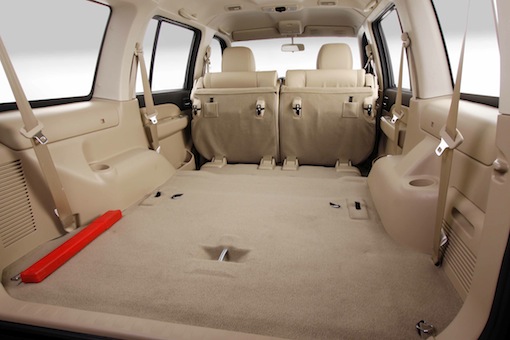
All Everests come as seven-seaters, unlike rivals that generally offer base five-seaters. A further ace in the hole for the Ford is how flat the second and third rows fold — which is very. Cargo space is 1060 litres with five seats in use, expanding to 2010L when the rear two rows are flat.

Dimensionally, the Everest is a shade bigger than an MU-X (70mm longer though the same width) and a few centimetres smaller than a Prado is most areas. It’s 60mm longer in the wheelbase though, and thereby gives excellent interior space.


The middle row also reclines and slides, while the Titanium’s electric folding rearmost seats are very useful. The pews are flat to increase cargo space when folded, but still comfortable in all rows, especially in terms of headroom.

Our test versions (Trend and Titanium) had rear ventilation controls, as well as plane-like roof-mounted vents covering all three rows. They made short work of the Thai humidity. The presence of a powerpoint behind the centre console is fantastic, though the Titanium should surely have screens embedded in the rear seats at this price point.


Up front, the dash design is very similar to that of the new Ranger, which is hardly coincidental, but no bad thing given that car sets the ute benchmark. The horizontal design themes create an illusion of width, and everything is well laid-out and logical.


There are tons of storage cubbies, including a glovebox that fits a 16-inch laptop, and at least six cupholders across all rows, with another four bottle holders in the doors.

Ford’s SYNC 2 system isn’t to all tastes, but the eight-inch screen split into four quadrants works well for me, the Bluetooth was rapid to pair and the voice control one of the most intuitive out there (as it is on the Territory).

Less ideal is the lack of reach-adjustment on the steering column. Ford defended this by telling CarAdvice that it calibrated the seating position to suit “95.0 per cent” of drivers. I guess I’m in the 5.0 per cent, as my hands never quite could get to the ideal placement. Here I was thinking I was a one-percenter…

Also less than ideal are the downmarket touches on even the Titanium, such as the lack of a starter button (you get a flip key), and the preponderance of hard plastics on multiple touch-points (though there’s a soft bit atop the dash). The ambience should be better on a car pushing $80K before on-roads, and you’ll not convince me otherwise. 


Engine and transmission:

Under the bonnet is the same Euro V 3.2-litre Duratorq turbo-diesel as the Ranger ute, albeit with some changes. It has 143kW rather than 147kW in the Ranger, but the same 470Nm of torque. This still edges the new 2.8-litre Prado’s 130kW/450Nm. 


Ford has changed the exhaust gas recirculation system, fitted new injectors and added sound insulation. The peak torque band is between 1750 and 2500rpm, a little narrower than the Ranger.

Maximum towing capacity is 3000kg — 500kg less than a Ranger, but equal to the MU-X and 500kg greater than a Prado — and you get trailer sway control. Fuel use of 8.5 litres per 100km is 0.6L/100km thirstier than the new Prado based on factory claims.

Matched is a six-speed automatic transmission that adjusts to your driving style.

Pulling power down low is strong, given the fact you get all that torque at 1750rpm, while the gearbox generally feels nicely calibrated to this iteration of the 3.2’s tune. It all does a good job of hauling what is a portly car — just under 2500kg in Titanium guise.

Ford has done a lot of work keeping noise and vibrations at bay inside the cabin, with lots of sound-deadening in the floors, the firewall and under the bonnet — a la the Ranger Wildtrak. There’s also electronic active noise-cancellation that works like your sound-deadening headphones that run off batteries.

It’s a little raucous from outside the car, but from the driver’s seat it does indeed feel commendably refined, the low diesel drone a distant rumble rather than a screech. All that insulation does have the reciprocal effect of highlighting the one very minor NVH issue we found: some slight throttle vibrations under mild load, through the drive-by-wire setup.


For background, we drove the Thai-market 2.2-litre four-pot diesel that isn’t coming to Australia. Naturally, it isn’t as effortless as the five-pot, but it would be serviceable as a price-leader.

Friday, August 14, 2015

ford atlas 2015


 more manly design makes this car more cool even though the car is its function to transport heavy goods but the car is still a luxury and dashing

Ford desired this vehicle to be effective in terms of fuel usage and some of the designers created a design that would certainly have a wind resistant front end with a radiator grille that appeared like a Fusion. Developers have actually also enjoyed with a glass roofing and back side that opens up and supplies access to devices and equipment for first assistance.In the end, Ford has chosen that Atlas is a conventional idea that gives a close preview 2015 F-150 models. Despite the fact that several of the ideas were declined, 2015 Ford Atlas has illuminated payload location which assists in discharging travel luggage in the evening.

Compared to its predecessor, the next F-150 will certainly be dramatically bigger and more aggressive, however nevertheless, Ford is preparing to reduce weight as much as 300 kg thanks to the use of light weight aluminum and various other light-weight products. The only puzzle that still reign the inside since 2015 Ford Atlas provides interior performed in the typical design of a principle auto, and it’s unsubstantiated that he might enter into production.

Features and details


Compared with its predecessor the 2015 Ford Atlas will certainly be considerably larger and a lot more vigorous, but still Ford intends to reduce weight by 300 kg thanks to using light weight aluminum and various other light-weight products. The only mystery that still reigns as the indoor Atlas offers indoor done in the normal style of a principle automobile, and it’s unsubstantiated that it might become part of manufacturing. We will certainly state a couple of words concerning mechanics.

ford focus st 2013

Exterior: 
Wide open maw, angry LED eyebrows over the top of HID headlights, and a serious panel gap where the hood meets the bumper up front. On the way to the back you'll find nice simple lines sitting fairly low over a set of 18's wrapped in mild performance tires. Once you get to the back you get a gander at my favorite angle: the big curvy taillights, a nice aggressive take on the classic Focus hatchback spoiler, and centrally located exhaust.


Interior: 
 Pour yourself into the seats and you know it's not your average Focus. The leather covered Recaro seats have large bolsters that hold you in place but don't tire you out on long drives; adjustable lumbar support would make these seats flawless. The steering wheel feels good and has controls for nearly everything. The boost gauge is fun to watch spike up and the cluster it is in on the top of the dash adds a unique line. There is a little plastic piece in the sunglasses compartment to hold your glasses in place; a neat little detail (I'm easily impressed).
Build quality is questionable; the headliner feels flimsy, the clips on the back seat don't hold the best when the seat is folded down which exposes the foam underneath, and the dash rattles in 3 different spots.


Acceleration: 
 With 270 lb.-ft of torque and 252 HP you will get from stand still to 60 in 5.9 seconds. You can drop the clutch and take some miles off tires if you'd like and, if the mood grabs you, can do it again with a hard shift into second gear. The owner's manual states it only requires 87 octane but running premium is definitely the way to go for best performance. Watch that redline; it seems to sneak up on you pretty quickly in first. Hold tight on the steering wheel when taking off; a heavy foot is a guaranteed trip to Torque Steer city.

 Braking: The brake dust is everywhere. I understand you can put low dust pads on but my god the rims were black by the end of the 3rdday. They stop the car quickly and the pedal feels good and firm. The handbrake pulls up about 36 inches and looks kind of weird when fully engaged but that's not so much anything to do with braking.


 Ride:Stiff enough to let you feel the road but not so stiff to wear you down. The drive home from the dealership was 180 miles on roads constantly under construction and I could feel they were rough but it didn't bother me.

Handling:Entrance ramps are fun with the Focus ST. I haven't pushed it to the edge yet but the performance tires do a great job holding you to the road when you're throwing it back and forth.\

 Audio: 
 I haven't stood behind it and had someone hit the pedal but from the inside it has a pretty decent note. The car has a feature that is essentially a port from behind the dash to the engine bay. Under spirited acceleration a valve in the port opens and pipes more engine noise into the cabin. I originally thought I was being tricked with engine noises played through my speakers… I feel better about this trickery.
The entertainment system is Microsoft based "My Ford Touch" and sounds pretty good. My car is optioned with a small woofer in the back which adds a little bump in your "trunk". The 16 year old boy in me enjoys this.


Gearbox: 
 The ST comes as a 6 speed manual. It's positioned well and feels good in your hand. Shifts are relatively quick. The shift light will drive you insane if you let it. Ford's EcoMode calculates Eco Ratings based on three categories: Shifting, Anticipation, and Speed. If you don't follow the shift lights you will certainly get 0/5 flower petals in shifting. The problem is the shift light doesn't give a shit what is happening in front of you, it just looks at your RPM's and where your foot is on the gas. Ignore the light and you'll be fine. Your Eco rating is likely to look something like this nearly all the time.


Wednesday, August 12, 2015

Ford Focus 2013


The Ford Focus changed the nameplate's image when it was new in 2012, taking it from lackluster to lap-worthy. Attractive, affordable, and fun, the Focus has won our Best Car To Buy award, as much for its trend-leading features as for its excellent front-drive handling.

the heat's being turned up with a seriously enthusiastic Focus ST. While most of the lineup gets a 2.0-liter direct-injected four-cylinder with 160 horsepower, and either a five-speed manual or six-speed dual-clutch automatic, the new high-perfoht guess; but it's surprisingly well-engineered, with none of the coarse or twitchy tuner-car feel that armance Focus ST packs a 240-hp turbocharged EcoBoost four and a six-speed manual—no automatic allowed. It'll get to 60 mph in just 6.3 seconds and to a top speed of 155 mph, numbers that call out to serious driving enthusiasts. Performance from the Focus ST is a rush, as you migffects the likes of the Mazdaspeed3 and Mitsubishi Ralliart. As for the rest of the Focus lineup, choose the manual gearbox and you'll have one of the best-driving small cars in the segment. You have to rev the engine to get to its perky side, but it's smooth, with a nice linkage.


The PowerShift dual-clutch automatic transmission in general does a good job keeping the revs up when you need it—but it can be rough at times at low speeds—and there's a Sport mode or you can control shifts on your own with a little +/- button on the side of the shift knob. The Focus handles as well as—or better than—the most deft handler in the class, the Mazda 3, with a suspension that doesn't crash and bang over rough transitions. Ford's electric power steering system provides nice weighting and it performs well, providing precise control but not transmitting much feel of the road.

(There's also a low-volume Ford Focus Electric model offered in more than a dozen U.S. markets. It's built on the same production line as other Focus variants, but dispenses with the gasoline engine and transmission, replacing them with a lithium-ion battery pack that runs an electric motor. The EPA rates the Focus Electric at 76 miles of range, and its price including delivery starts at $39,995. Ford appears to be only lukewarm on its most advanced Focus; throughout 2012, it sold just 685 of them nationwide. The 2013 Ford Focus Electric continues unchanged from the 2012 model.)


The Focus blends creases and curves with an overpowering front-end design and thin front grille, a new Ford design cue shared with the Escape. We prefer the hatchback by far to the stubby-tailed sedan. The instrument-panel design doesn't at all hold back inside, and while some may find it overly swoopy and almost too stylized, its vertically-oriented vents and pleasant surface sculpting look and feel original in a crowded class of look-alike small cars. Ford offers several trims to cover a wide range of expectations, but we find the Focus tends to look best in the top Titanium trim, where all the details are well coordinated.

Inside, the Focus can feel more like a European sport sedan than a budget-priced hatchback. Add the upgraded sport seats of the Titanium model and you'll find even better support than the already impressive base front seats. Whether you choose the sedan or hatchback, you get back seat accommodations that are virtually the same, with just enough legroom and headroom to fit even those over six feet. With the leather upholstery, there's no skimping on look and feel in back; you won't get mid-size comfort, but there's enough comfort back there for most six-footers. Our most significant complaint concerns the instrument panel design, which cuts into front passenger knee space.


Safety-wise, the Focus holds strong; it's one of the few compact sedans to have earned both a five-star NCAP Overall Score and IIHS Top Safety Pick status.

The Focus still is offered in a cost-conscious Focus S base model, but the true focus is toward those well-equipped, tech-loaded upper trims like the SEL and Titanium. A loaded Titanium can hit $28k, but these models include MyFord Touch, an upgraded ten-speaker Sony sound system, HD Radio and Sirius Satellite Radio, sport seats, a sport suspension, and sport wheels with summer performance tires.

Active Park Assist, which helps you steer into a parallel-parking space, is optional in upper-level Focus models and is one of several segment-exclusive tech features. MyFord Touch, with text-to-voice capability and WiFi capability, is also available.


go to my blog new ford car